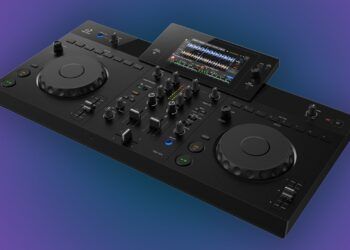
AlphaTheta announced the CDJ-1500X today, its first budget-minded, heavily featured media player since the XDJ-1000MK2 launched back in September 2016(!!). At $1,699 retail, it undercuts the CDJ-3000X flagship by roughly $1,300, and it carries over most of the CDJ-3000X’s screen and cloud features, in a design built for 2026 rather than a decade-old body style.
It also ships alongside CoBeat, a new AlphaTheta service that puts crowd song requests directly on the CDJ’s screen. The CDJ-1500X is the first player to support it.
Keep reading for the full news and details so far.
- CDJ-1500X: $1,699 MAP excluding tax, US; €1,699 including VAT
- Retail release/ship date coming soon; available for preorder in DJTT store now
- CoBeat + supporting rekordbox update: July 9, 2026
The Price Bracket AlphaTheta Hasn’t Touched Since 2016
AlphaTheta’s press release frames this as a player for bars and small clubs, but to me, the compelling story is price bracket: it’s the first time since the XDJ-1000MK2 that AlphaTheta has built a fully featured media player at this end of the market. Like the ten year old unit, the CDJ-1500X is noticeably smaller in every dimension than the CDJ-3000X and roughly 40% lighter. It’s also smaller than the XDJ-1000MK2 in width (about 2 inches less wide) and has a noticeably smaller jogwheel:

The XDJ-1000MK2 launched in September 2016 at $1,299 and is still the closest comparison, with a smaller screen and none of the CDJ-3000X’s touchscreen or cloud tools. Denon DJ’s SC6000 Prime sat in similar territory too, though it’s worth noting Denon DJ has since discontinued it; remaining stock goes for around $1,250, and it had a 10.1-inch touchscreen and digital output (which is MIA on the CDJ-1500X).
As recently as two months ago, the XDJ-1000MK2 was still selling new for $1,359 a decade of price creep on hardware that’s now nearly ten years old. Paying $350 more for a current-year unit is a reasonable trade, though it’s a rough one for anyone who bought in over the last few years.
AlphaTheta already hinted at this direction back in January of this year with the DJM-V5, a smaller, more affordable mixer built on the DJM-V10’s sound. DJs on Reddit connected the dots almost immediately: threads on /r/DJs were ripe with speculation that a stripped-down, CDJ-style player had to be coming too, the other half of a matching budget pair. Six months later, here it is.
The 10.1-inch touchscreen, straight from the 3000X
The CDJ-1500X uses the same 10.1-inch capacitive touchscreen as the CDJ-3000X, which makes sense given how much of a DJ’s set happens on that screen. It’s the single most-used part of a modern CDJ, and cutting corners there would have undermined the whole pitch. The browse screen shows up to 15 tracks at once (one fewer than the CDJ-3000X’s 16, for whatever that’s worth), and the main waveform now marks vocal positions, BPM change points, and phrase structure directly on the display.

Playlist Edit lets you reorder a playlist on the unit itself, no laptop stopover required. Dark and light display modes are here too, which matters for anyone who’s tried to read a CDJ screen at a sunny day party, though the images in the release seem to show the waveform is still on a black background while the UI stays white – a bit odd (see above.
Cloud connectivity and NFC login
Built-in Wi-Fi on the CDJ-1500X enables rekordbox CloudDirectPlay, along with StreamingDirectPlay access to Apple Music, Beatport Streaming, and Tidal. The player has a NFC touch login (tap your phone, loaded with the rekordbox mobile app, on the unit) which pulls in your settings and playlists automatically.
This is the same pitch AlphaTheta made with the CDJ-3000X last year: show up with just a phone and start playing. It’s a nice idea for a gig where you didn’t bring your usual USB. Whether DJs should/will actually trust a bar’s Wi-Fi over a USB stick they know works is a separate question.
Design that feels more “Omnis Duo” than “CDJ-3000X”
Matte black finish, 12 LED lighting colors, and screw holes on the sides for optional custom panels are the CDJ-1500X’s own design signature, not something inherited from the CDJ-3000X, which uses an aluminum top panel instead.

Let’s talk about the USB bay at the front of the unit. AlphaTheta calls it a “front panel” bay, but the USB-C and USB-A ports are nested under the front edge and the cubby is lit from below with a user-selectable underglow (choose from 12 colors for the LED lighting). That’s a good way to streamline the unit and protect drives in a crowded booth. But it also raises a practical question: is it now harder to pull a drive out quickly mid-set without pushing the whole CDJ by accident? We’ll need to test on our (still forthcoming) review unit.

Looking at the industrial design as a whole, the CDJ-1500X reads like a sibling to the Omnis Duo, AlphaTheta’s portable all-in-one from 2024, rather than a shrunk-down CDJ-3000X. It shares enough of that unit’s visual language that the CDJ-3000X ends up looking a generation older sitting next to it in press photos:

Looking newer isn’t the same as being built better, though. A sleeker, more angular design like this could just as easily hold up worse over time than the CDJ-3000X’s chunkier, more established shape. AlphaTheta’s own recent history is a reason to wonder rather than assume: we’ve heard from sound techs and rental houses that the original CDJ-3000 held up worse to festival-length abuse than the older NXS2 units it replaced, despite looking like a clear upgrade on paper. Only hands-on time, and more importantly, months of real world DJ use, will actually make clear the unit’s build quality.
A loop encoder finally makes it onto a CDJ, but the pads didn’t
The Beat Loop knob is a proper loop encoder, the rotary control that’s shown up on the Omnis Duo and Opus Quad but never on a media player unit from AT/Pioneer DJ until now. It’s a small thing, but DJs who’ve used those all-in-ones (or Traktor and Denon DJ users) will be very happy to see it here.
That said, we’re not sure that Beat Jump/Loop Move made it to physical controls. The manual seems to explain that Beat Jump functionality lives entirely on the touchscreen – despite shift + the loop encoder being an obvious control for it. Moving loops or doing beat jumps, without ever touching the screen would be a killer feature here, especially for anyone coming over from Traktor or Denon gear, where that kind of hands-on-hardware muscle memory is the norm. (We’ve asked their team for clarification here, and are waiting on a reply)

The browse knob uses the same physical encoder housing – moving away from the well-established wide and flat encoder that has been used on almost every CDJ and XDJ unit until today. A similar break from design is present with the Cue and Play/Pause buttons. They’re the same matte gray as the rest of the unit, which fits the overall look, but unlike any CDJ of the past.
Worth noting, still no performance pads on this unit. The CDJ-1500X sticks with 8 dedicated Hot Cue buttons labeled A through H, the same as on the CDJ-3000, rather than the pad grid AlphaTheta uses on its controllers and all-in-ones.
Ports: USB-C power, Ethernet, RCA, no digital out
The rear panel carries USB-C power in (another CDJ first), an Ethernet port for Pro DJ Link, RCA audio out, a separate USB-C port for a computer connection, and a Kensington lock slot. Digital output isn’t here, and it’s honestly a bit of a shock since the XDJ-1000mk2 had it.

On USB-C power: the unit probably won’t run off a phone-style USB battery pack, but it might work off a USB-C PD (Power Delivery) charger and cable, the kind that ships with a MacBook, for instance. That’s not tested yet, I’m just basing this on the power specs in the manual. It’ll be interesting to try, especially since the lack of an IEC power port means having a solid backup option is worth knowing about.
CoBeat: crowd requests built into the hardware
There’s new service software alongside this release in terms of request management (likely designed to get DJs into AT’s paid subscription world). CoBeat lets a DJ pre-load a catalog of tracks, generate a QR code, and let the crowd scan it to vote for songs from that list or send other requests. Everything lands on the CDJ-1500X’s browse screen, ready to drop in. People at the party can react to each other’s requests with emojis too, and those reactions pop up on the DJ’s phone in real time.

Crowd interaction tools aren’t new, and the track record is littered with attempts. I covered tools for reading and engaging a crowd back in 2014, and Virtual DJ built its own Ask The DJ request engine in 2016. Search around and the list gets long fast: RequestNow, Tell the DJ, YoDJ, RequestBox, and Lime DJ are just five of a much bigger pile of independent request apps built over the past decade, mostly for mobile DJs rather than clubs.
CoBeat living on the hardware itself is a different context for the idea, but it doesn’t change why a lot of DJs never adopted these tools: plenty prefer handling requests person to person, or refusing them outright, as part of how they run a set.
What AlphaTheta adds on the technical side removes the phone-fumbling step and keeps requests limited to a pre-approved catalog. Still, a screen full of requests and emoji pop-ups mid-set is one more thing competing for a DJ’s attention on top of cueing, mixing, and reading the room, and CoBeat depends on the same venue Wi-Fi that’s already a soft spot for cloud features on this player. It launches alongside the rekordbox for Mac/Windows update that supports it on July 9, about a week after today’s announcement.
What’s missing
No digital output. RCA is the only audio out on this unit. A digital run into a mixer or snake is standard on CDJs in this price range, and the SC6000 Prime offers it; the CDJ-1500X doesn’t.
No standard IEC power inlet. Power runs through USB-C via the included AC adapter rather than a direct IEC connection on the unit itself, which is what most CDJs use so a tech can grab any spare cable sitting in the booth. Lose or forget the CDJ-1500X’s specific adapter and a USB-C PD charger is your backup, not a generic replacement cable.
Serato and djay both need a paid subscription. Compatible software includes rekordbox for Mac/Windows (hardware unlock), rekordbox mobile (no license needed), Serato DJ Pro, and djay Pro, but the latter two both require an active subscription to use with the unit. Worth flagging, though most people buying a CDJ-1500X are probably running rekordbox anyway, so this is a minor catch rather than a real deal-breaker. Worth noting the alternative too: Pioneer split hardware into separate Rekordbox-only and Serato-only SKUs a decade ago, and it flopped, expensive deadstock even before factoring in today’s tariffs and rising component costs. One SKU that works across all three platforms is the cheaper bet for AlphaTheta this time, not just the more DJ-friendly one.
No stems support – not a big surprise, this matches the CDJ-3000X. If you were hoping the smaller player would be where AlphaTheta finally added it, it isn’t happening here either.