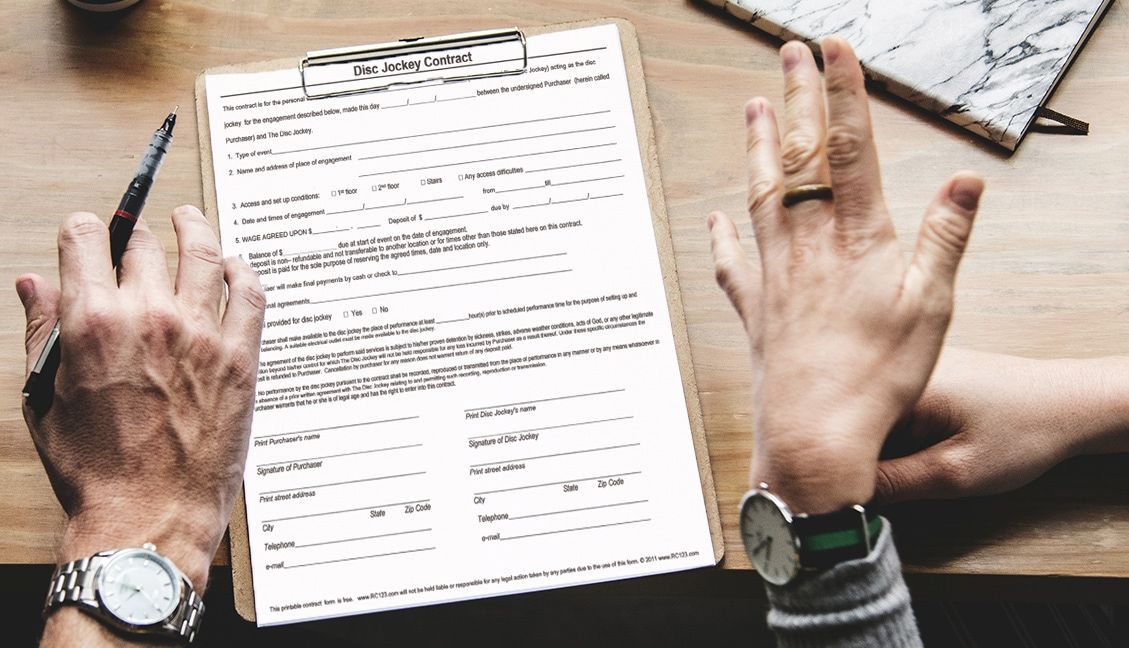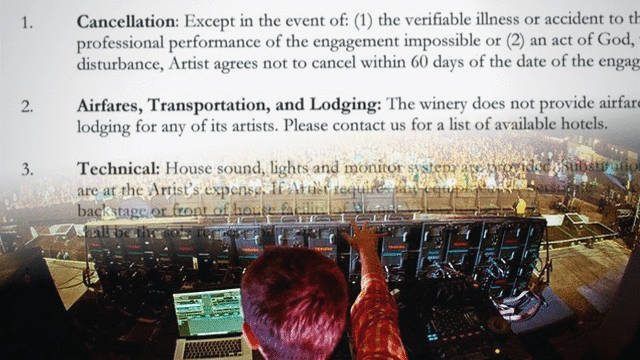
Negotiating a DJ performance contract can be a tricky thing, but doing it right is an essential step in turning your hobby into a career. Today, we discuss considerations for DJs that sign performance agreements, and provide some tips for minimizing risk and maximizing return. In a new column, Legal Concerns for DJs, our favorite lawyer and legal expert Noah Sutcliffe shares his tips to making your paperwork quite a bit easier!
Contracts and Riders
Any music performance agreement has two parts: the basic contract and the rider. Let’s start by breaking them down and figuring out which covers what!
The basic contract generally identifies the parties and covers the date, time, fee, and any payment splits or guarantees if the fee is scalable based on attendance, bar sales, etc. A radius clause (limiting performances in the same geographic area before and after the show) might also appear in the basic contract.
The rider covers everything else – from cancellation policy to transportation, equipment, comps to catering preferences. The reason for this division into basic contract and rider is that different DJs (and different musical acts of all varieties) have vastly different needs, expectations, and levels of bargaining power. At the same time, it’s likely that a given DJ will have the same needs and expectations for any gig he plays at a given stage in his career. The rider provides an easy way for that DJ to ensure his needs are met without having to rewrite a standard form contract every time he plays a show.
In most cases, the basic contract is provided by the club and the rider is provided by the DJ. From time to time, you may see the basic contract discuss a term that is also discussed in the rider. This is only relevant if the terms contradict each other in any way. If that happens, the best way to ensure that the term in the rider will prevail is to include language in the rider itself that says something like:
“In the event a discrepancy should arise between the provisions of this Rider and the provisions of any other part of this Agreement, the provisions of this Rider shall apply.”
Fee
The basic contract will generally be on a form provided by the club and will look very simple – to the point where if you stand far enough back, you may think you’re looking at an invoice from a hardware store. The first part you’ll want to examine is the fee section.
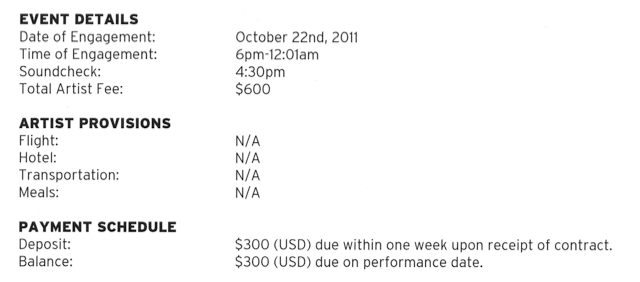
In addition to the amount specified, the fee section will likely include information about the payment schedule and (possibly) the cancellation policy. The payment schedule describes when and how you will be paid. Obviously in the perfect situation, you’d be paid 100% of your fee up front. This almost never happens, even for big name artists. The club wants to make sure that you show up, and they don’t want to be chasing you down to get their money back if you don’t.
The cancellation policy describes what will happen to your fee if the show doesn’t end up taking place. Part of the cancellation policy will deal with horrible eventualities like fire, flood, strike, or nuclear attack. Equally important (though less visually evocative) are common occurrences like illness, transportation delays, and closure of the club by local authorities. The most important thing with respect to all of these is that you not be responsible for any loss or damage that results from your inability to perform due to circumstances beyond your control. You don’t want to end up being sued by the club because you were too ill to walk, or because your car was destroyed by vandals hours before your set. The other part of the cancellation policy deals with voluntary cancellation, or the situation where either you or the club decide to terminate the contract before your performance.
The ideal payment proposal that I recommend to my clients here is 50% of the fee due on signing and 50% due within an hour after the set is complete. The initial 50% should be non-refundable in every event except the DJs voluntary cancellation. This is good for the club and the DJ because it gives both an interest in completing the contract: the club has an initial investment in the DJ and the DJ needs to play to receive the full fee. It also allows the DJ to settle for a less protective cancellation policy because the up-front portion of the fee covers the opportunity cost if the show doesn’t take place.
If the club refuses to pay anything in advance (which clubs often do), then try for language that says the club owes 50% of the fee if they cancel within 48 hours of set time, or 100% if they cancel within 24 hours. If even that fails, you can ask for a rebooking provision that requires the club to book you again if they cancel.
For many DJs, the potential to play at a big–name club may be worth more than the security of guaranteed money or a cancellation fee. But, once you’re a “working artist” with income expectations, it makes sense to strive for these terms.
Amenities
Next up, equipment you put in your rider. Ask for your ideal setup as far as mixer, turntables, CDJs, monitors, mics, P/A, lighting, power sources, and anything else that matters for your set. Be specific! The club can always say no or ask if you’ll settle for something else, but try for the best setup possible. When it comes to the mixer, CDJs, or turntables (if you use them), give actual model numbers and specify that they must be approved in advance. With the other equipment, technical specifications will usually suffice, but it will help the club get you the right gear if you also suggest particular models that fit your criteria. Finally, include an outward time limit for sound-check so that you have the opportunity to make sure everything is working properly.

You may be saying to yourself, I already have my own DJM-900, why don’t I just bring it? Here’s why:
- It’s better to carry less
- You’re likely to be playing on a bill with others. You want to be able to mix in, or at the very least have levels set when you start. This isn’t possible if everything has to be broken down between sets.
- By not bringing your own equipment, you will ensure that your gear is safe at home while Steve Aoki pours champagne on someone else’s $2,000 mixer.
On that note, be sure to specify that the club’s insurance will cover any damage to the gear you do bring.
Stage furnishings are another vitally important section of your rider, and specificity is of paramount importance here. Make sure to specify the table height you need and any stools, chairs, lamps or fans that you want as well. Food, drink, and guest-list comps are also included in the rider, but these will obviously vary greatly with the level of club and performer. Finally, if the gig is in another state or country, don’t forget to include transportation, lodging, and a per diem, as these can quickly amount to more than the performance fee.
Marketing, Publicity, and General Provisions
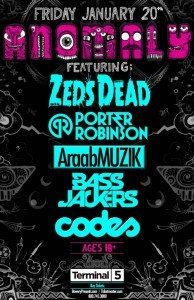
The rider also allows you to specify how you want yourself billed for a performance, and at a minimum to ensure that you’re included in all promotional materials related to the show. Those are especially important if you’re opening for big-name artists, so that you can piggy-back on their exposure.
In order to use your information in their promo materials, a club will likely ask for a temporary license to use your name, likeness, and potentially copyrighted material for the purposes of promoting the show. Just make sure that such a license is temporary, and that it doesn’t include allowing the club to distribute any material (including music, performance videos, mixtapes or compilations) that might be prohibited by your record deal.
General provisions for club security, non-transferability and other general provisions like an indemnity are often included in the rider as well. Suffice it to say that non-transferability means that you can’t sub in someone else to play your set and still collect the fee; and indemnities . . . well you can read about those here.
Sign Me Up!
Those are the basic elements of a DJ performance agreement and some ways you can make them work for you. In closing, let me leave you with a couple of basic tips:
1) Always know the position from which you’re negotiating: don’t take risks if you don’t have to; but on the flip-side, be aware that if you’re too demanding you may risk losing a deal completely.
2) It’s almost always impossible to get everything you want in a contract, but it’s almost always possible to get a particular thing you want in more than one way. If a club rejects some part of your rider that you feel you need, try adding something else that will offset that change.
3) In every case, use the plainest, simplest language possible. The language in most simple contracts is far more complicated than it needs to be. For real legal advice and protection, you should always be represented by counsel, but in the event that you need to make a change to your rider on your own, your best bet is to write exactly what you mean in plain English.
Next time on Legal Concerns for DJs, we discuss copyright laws or public performance royalties. Stay tuned for a discussion of that and other intellectual property concerns coming soon!
Noah Sutcliffe runs his own legal blog that’s as excellent as he is – check it out over at LawCue.com.
The issues posted and discussed in this column are provided only as a service to the DJTT internet community. Noah and DJTT are not providing legal advice, nor are they soliciting clients.