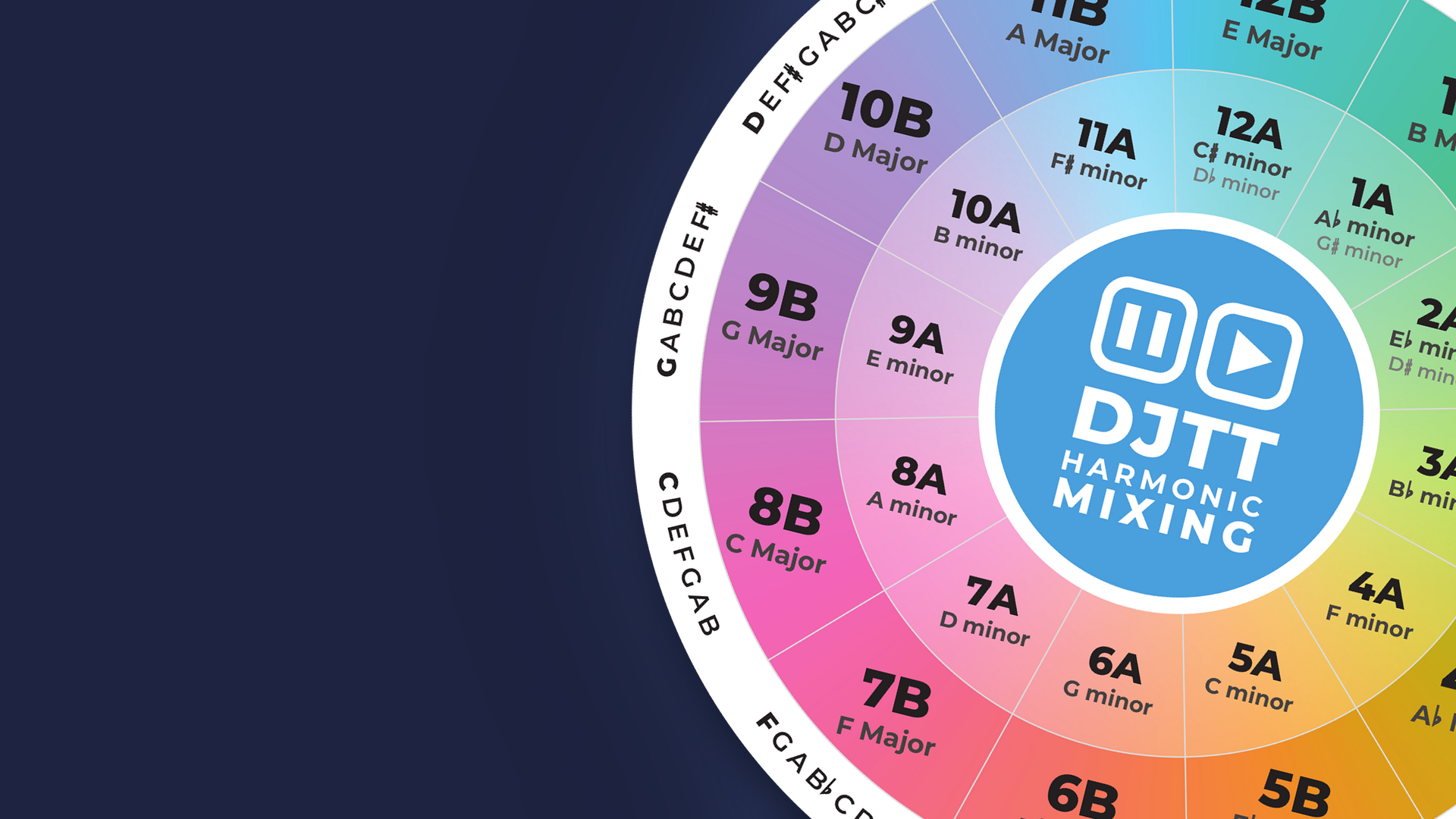
An updated 2026 version of our fun harmonic mixing wheel sticker is in the store now. It’s 3″ now, up from the smaller 2″ version in our sticker pack (yes, you can still get those!). Since we put out the original in 2020, we’ve seen it on laptops and slapped on the inside of DJ booths. For this one we reworked the design so you can read it in a dark booth.
If you haven’t used one, the wheel is a circle of fifths set up for mixing in key. Find the key of the track that’s playing, then mix into the keys right next to it. It uses the same number-and-letter codes (8A, 8B, and so on) as Mixed In Key’s Camelot wheel, with each minor key on the inner ring sitting beside its relative major.
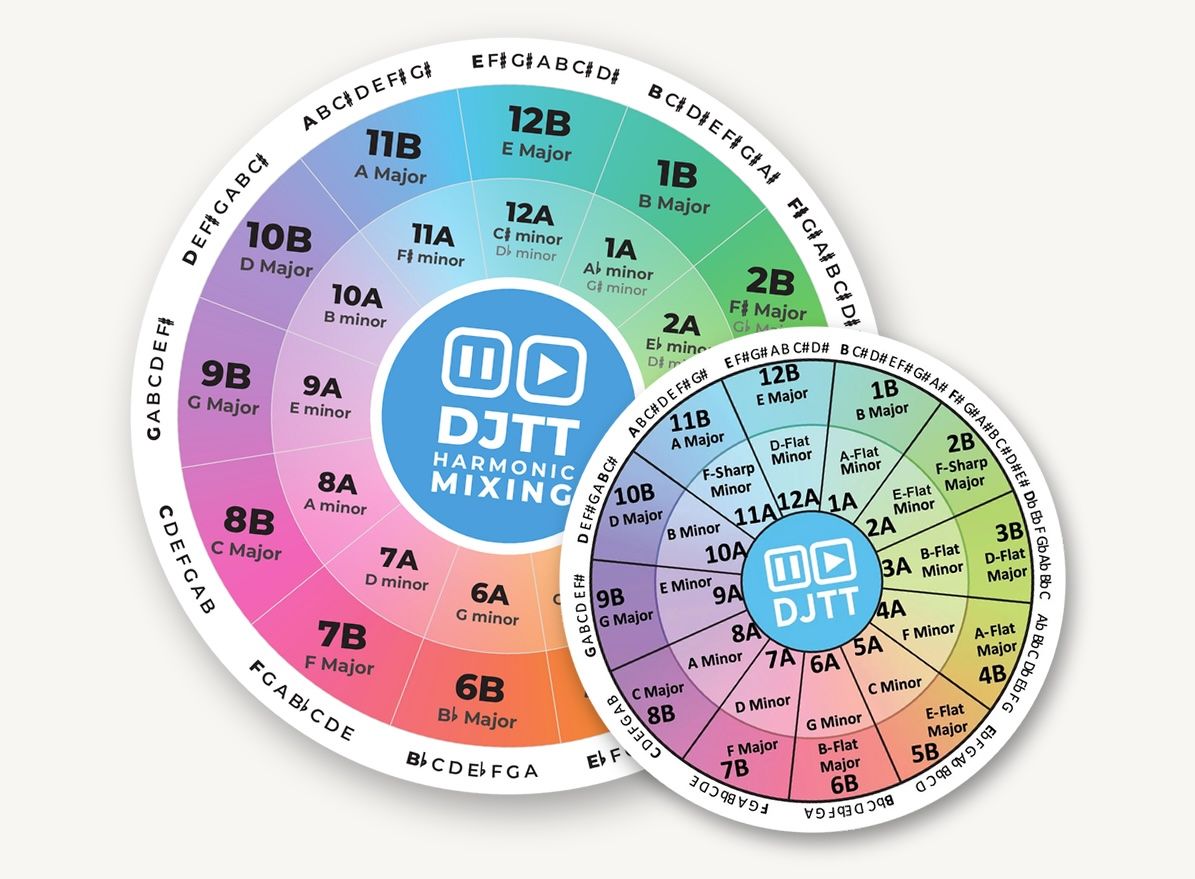
What’s new on our 2026 harmonic mixing wheel
Four of the keys go by two names depending on which software analyzed your DJ library and what your analysis settings are, so the wheel now shows both spellings for G#/Ab minor, D#/Eb minor, C#/Db minor and F#/Gb major. If one DJ software tags a track Ab minor and another calls it G# minor, you’ll be able to use the sticker either way.
On the theory side, the major scales on the outer ring are spelled out, and each inner key is the true relative minor of the major key beside it. Going clockwise, every step is a perfect fifth.
The other changes ended up being mostly about making it more legible from a distance. We swapped the spelled-out “F-Sharp” and “Bb” for real sharp and flat symbols, made much of the text bigger, and updated the colors and text used. All of it might feel like “minor” (pun somewhat intended) updates, but I figured it was worth taking the time while scaling up the design to the larger size.
Moves to try on the harmonic mixing wheel
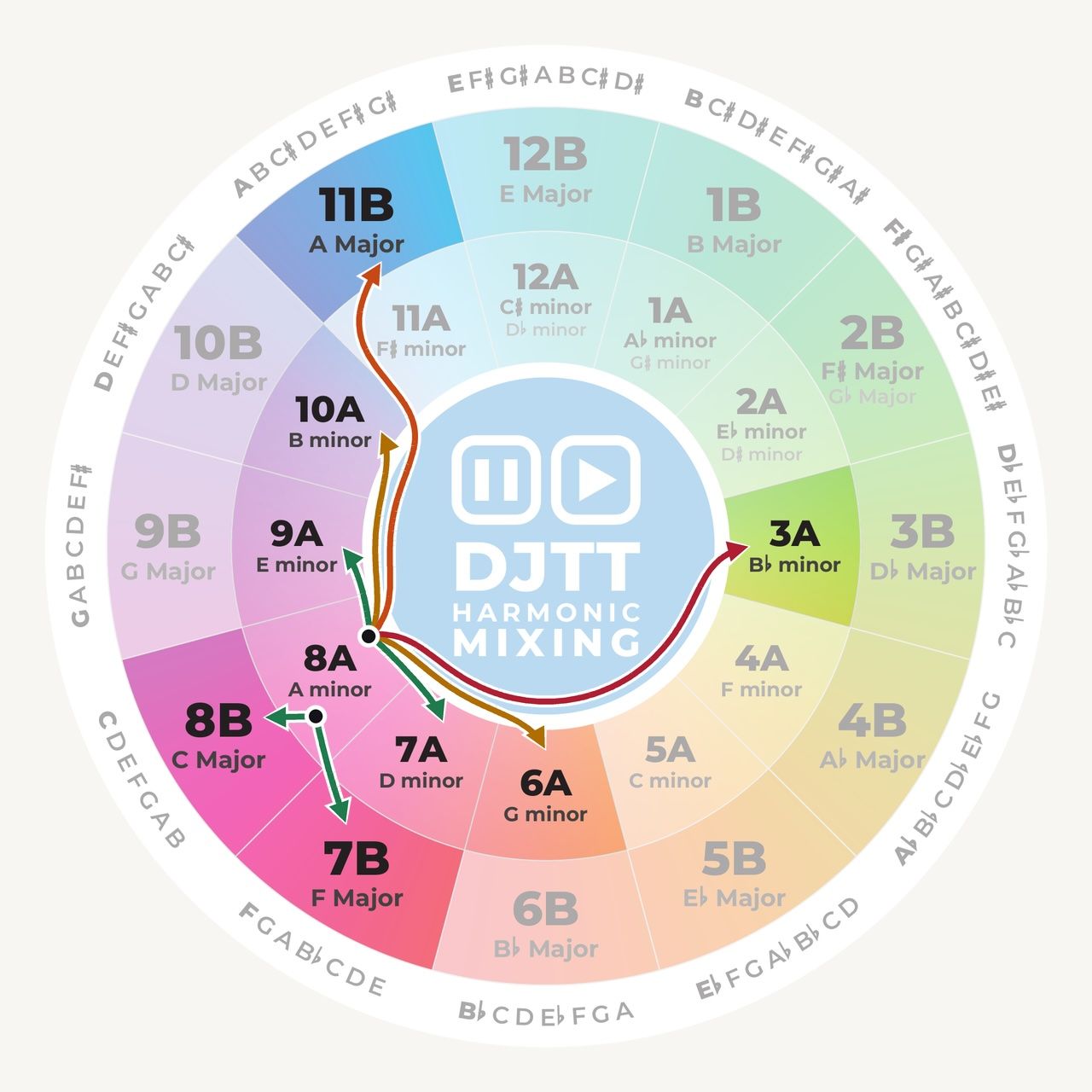
Each example below starts from 8A. I’ve noted also how many of the seven notes the two keys share. There are other moves you could try, but let’s call these the most common and easiest to remember?
- Same key (8A to 8A). All 7 notes match. The safest for long blends or putting vocals over instrumentals.
- One step (8A to 9A or 7A). 6 of 7 notes match. This is the common “near”-key mix.
- A/B flip (8A to 8B). Same notes, minor to major (or back). It’ll often feel like a mood change, even though there isn’t a single new note.
- Diagonal (8A to 7B, or 8B to 9A). 6 of 7 notes match, and it changes the mood and the key in one move.
- Parallel flip (8A to 11B, or 8B to 5A). Keeps the same root note and swaps minor for major, so only 4 of 7 notes are the same. Keep these mixes quick and don’t let the melodic parts of each track overlap for long.
- Energy boost (8A to 10A). Moves up a whole step with 5 of 7 notes matching, for lifting into a peak. Yes, you can go two steps the other way (8A to 6A) to wind down.
- Half step up (8A to 3A). Add 7 to go up a semitone. Only 2 of 7 notes will match, so make it a quick cut mix, probably.
Why put a harmonic mixing wheel on your gear?
Every major DJ app tags a track’s key, and CDJs show it on screen, but working out which keys sit next to it is still on you. There’s also that magic moment where you’re playing B2B and your fellow DJ has their key display set differently than yours. What the hell Camelot key is E major, again? I don’t know, but that’s why I made this sticker. Having the wheel stuck somewhere in your booth might make it a little bit easier for ya.
Price + where to get your sticker!
It’s $5 in the DJTT store. It’s a quality sticker, so it’ll hold on a CDJ cover or a hard case, and you can wrap it around a water bottle too.
Want some throwback Mojaxx? If you’re on Pioneer gear and want more out of your key tags, his harmonic mixing on CDJs tip is a good next read.